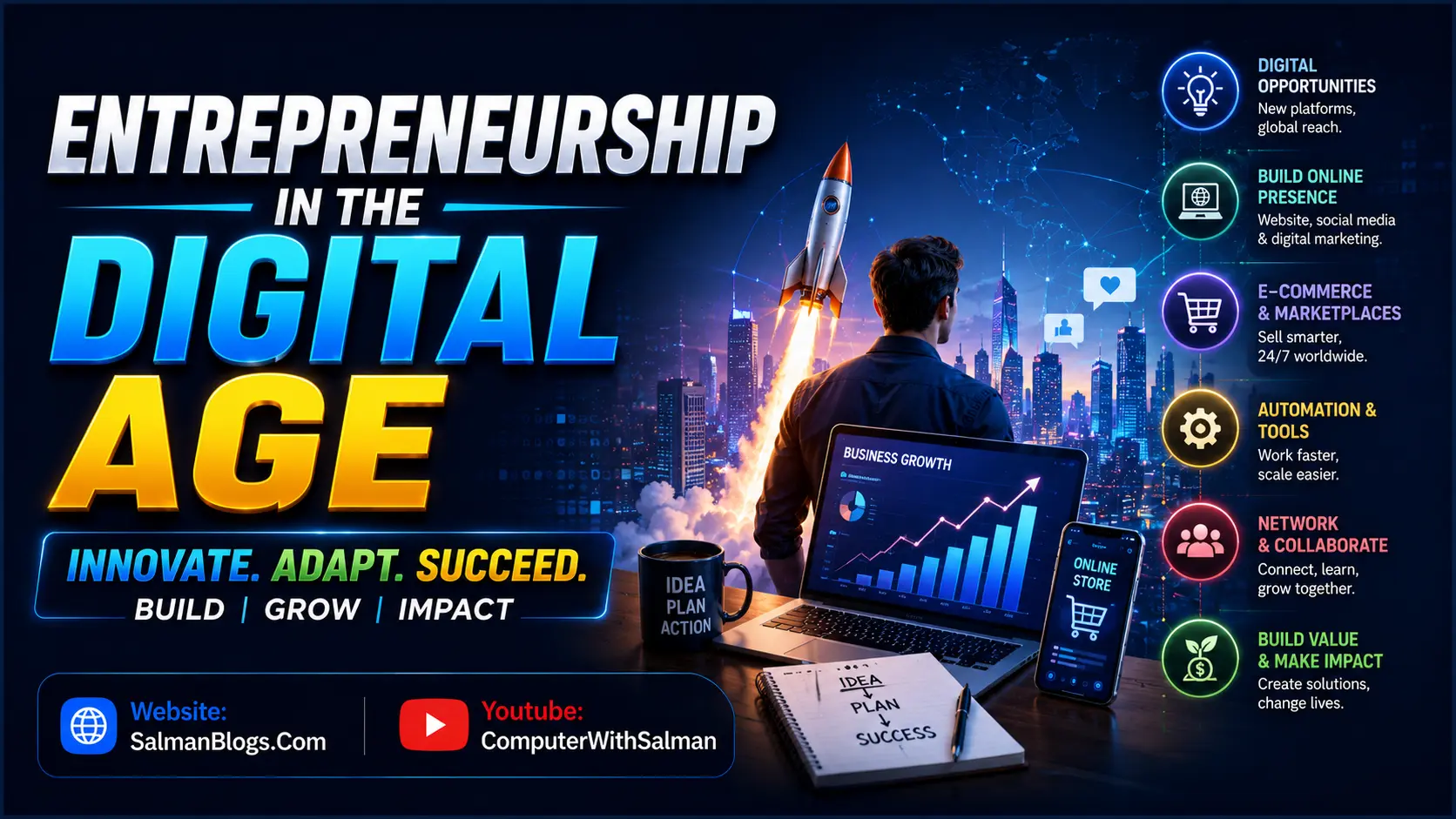
Entrepreneurship
Entrepreneurship is the process of starting a new business by finding a market need and creating a solution for it.
Examples:
- Opening a mobile repair shop in a town where no repair services are available.
- Starting an online clothing store to sell custom-designed clothes.
- Creating a tutoring center for students who need extra help in studies.
Examples of Entrepreneurship
Tech Startups
Technology companies often start with a simple idea and grow into large businesses.
Examples:
- Facebook started as a small social networking website.
- Google began as a search engine project.
- Apple started by creating personal computers.
Today, these companies are among the world's biggest tech companies.
Local Businesses
Local businesses are businesses that are located near you or within your community and provide goods or services to people living in that area.
Examples:
- A bakery selling fresh cakes.
- A clothing shop selling dresses.
- A mobile repair shop.
Key Characteristics of Entrepreneurs
Entrepreneur
An entrepreneur is a person who starts and manages a business by identifying a need in the market and taking risks to provide a solution.
Successful entrepreneurs usually have these qualities:
1. Innovation
Innovation means creating something new or improving something that already exists.
Example: Adding online ordering to a restaurant so customers can order food from home.
2. Risk-Taking
Starting a business involves uncertainty. Entrepreneurs must be willing to take risks.
Example: A person spends their savings to open a café, hoping customers will come.
Why is Entrepreneurship Important?
Entrepreneurship is important for the growth of society and a country's economy. It creates opportunities, solves problems, and improves people's quality of life.
1. Economic Growth
Entrepreneurship boosts a country's economy by creating businesses, producing goods and services, and generating jobs. This increases national income and reduces unemployment.
Example: A new factory hires 100 workers, helping reduce unemployment and increasing the country's income.
2. Innovation and Progress
Entrepreneurs introduce new ideas and technologies that improve life and support a country's development.
Example: Smartphones changed communication, education, and business worldwide.
Entrepreneurship in the Digital Landscape
Digital technology has transformed the way businesses are created, operated, and managed.
Digital Transformation and Entrepreneurship
Digital transformation refers to the use of digital technologies to change how businesses operate and deliver value to customers.
Example: Selling clothes through an online store instead of a physical shop.
Role of Digital Technologies
Digital tools help businesses reach more customers, improve efficiency, and operate more effectively.
1. Social Media
Social media platforms such as Facebook, Instagram, X(Twitter), YouTube, WhatsApp, and TikTok help businesses promote their products and connect with customers.
Examples:
- A bakery posts pictures and short videos of cakes on Instagram and TikTok to attract customers.
- A clothing brand uses Facebook and Instagram ads to promote new arrivals.
- A restaurant uses WhatsApp to take orders and share daily menus with customers.
- A tech company uploads product tutorials on YouTube to explain how their products work.
- A small shop uses X (Twitter) to announce discounts and special offers.
2. Mobile Apps
Mobile applications allow businesses to provide services directly through smartphones.
Example: Food delivery apps let customers order food easily with a few taps.
3. Cloud Computing
Cloud computing stores data on the internet instead of local devices, allowing access from anywhere.
Example: A company stores customer records online so employees can access them from any location.
4. Big Data Analytics
Big data analytics helps businesses study large amounts of data to understand customer behavior and market trends.
Example: An online store analyzes customer purchases to recommend relevant products.
Digital Marketing and E-commerce
Digital Marketing
Digital marketing means promoting products and services through online platforms to reach and attract customers.
Example: Running ads on social media to attract potential customers.
Digital Marketing Strategies
1. SEO (Search Engine Optimization)
SEO is the process of improving a website so it appears higher in search engine results.
Example: A bakery website appears on the first page when someone searches “best bakery near me.”
2. Social Media Marketing
Social media marketing involves promoting products through platforms like Facebook, Instagram, and X(Twitter).
Example: A clothing brand posts new designs and offers on Facebook and Instagram.
3. Content Marketing
Content marketing focuses on creating useful and engaging content to attract and retain customers.
Example: A fitness company shares workout videos and health tips to engage users.
4. Email Marketing
Email marketing involves sending promotional emails and updates to customers.
Example: An online store emails customers about discounts and special offers.
E-commerce Platforms
E-commerce platforms are online tools that help businesses sell products and services over the internet.
Examples:
- Shopify: Helps create and manage online stores.
- PayPal: Provides secure online payment services.
- Zendesk: Offers customer support and service solutions.
Business Idea Generation
Business idea generation means identifying and developing new business opportunities by solving real problems in the market.
Problem Identification
The first step in generating a business idea is identifying problems or needs that people face in their daily lives.
Ways to Identify Market Needs
1. Surveys and Questionnaires
Surveys and questionnaires are used to directly ask people about their needs and preferences.
Example: Students are asked which school supplies they need most.
2. Market Research
Market research involves studying customer behavior, demand, and current market trends.
Example: Research shows that online shopping is becoming more popular.
3. Observation
Observation means carefully watching how people use products and services in real life to identify problems and opportunities for improvement.
Example: Seeing customers wait a long time to pay at a store leads to the idea of self-checkout machines, a system in a store where customers scan and pay for their items themselves, without a cashier.
Creative Problem Solving
Creative problem solving means using new and innovative ideas to find solutions to problems.
Design Thinking Process
1. Empathize
Understand people’s needs and problems by talking to them and observing their situation.
Example: Talking to farmers to understand their daily challenges.
2. Define
Clearly identify and describe the main problem.
Example: Farmers do not receive timely weather updates.
3. Ideating
Think of multiple possible solutions to the problem.
Example: Designing a mobile app that provides weather information to farmers.
4. Prototype
Create a simple version of the solution to test the idea.
Example: Making a basic design or demo of the weather app.
5. Test
Try the solution with users and collect feedback for improvement.
Example: Farmers use the app and suggest changes to make it better.
Developing Business Plans
Developing a business plan is essential for any entrepreneur. A well-crafted business plan provides a roadmap for success by clarifying ideas, identifying challenges, and outlining strategies for growth.
Creating Comprehensive Business Plans
A business plan is a detailed document that outlines business goals and the strategies used to achieve them. It works as a blueprint for the business, helping entrepreneurs stay organized and focused.
Components of a Business Plan
A comprehensive business plan includes several key components:
- Executive Summary
- Mission Statement
- Company Background
- Product Description
- Market Analysis
- Marketing Plan
- Competitor Analysis
- Financial Planning
- Operations Plan
- SWOT Analysis
- Timeline
Market Analysis
Market analysis involves studying the target market to understand customer needs and preferences. It includes analyzing market trends, competitors, and the target audience.
Revenue Models
A revenue model explains how a business earns money, including pricing methods, expected income, and different ways of making money.
It answers questions such as: What is paid? Who pays? How is payment made? And for what is payment received?
Prototyping and Iteration
Prototyping involves creating a basic model of a product or service to test and improve the idea. Iteration is the process of improving it based on feedback.
Building Prototypes: Prototypes can be simple sketches, digital models, or physical samples used to visualize and test ideas early.
Ethical and Sustainable Entrepreneurship
A business should not only focus on profit but also act responsibly toward society and the environment.
Ethical Entrepreneurship
Ethical entrepreneurship means running a business in an honest, fair, and responsible way.
Principles of Ethics
1. Honesty
Honesty means always telling the truth and giving correct information.
Example: Providing accurate details about a product to customers.
2. Integrity
Integrity means doing the right thing even when no one is watching.
Example: Paying taxes honestly without hiding income.
3. Fairness
Fairness means treating all people equally and without unfair judgment.
Example: Giving equal job opportunities to all applicants.
4. Respect
Respect means valuing the rights, feelings, and dignity of others.
Example: Treating employees politely and respectfully at work.
Sustainable Development Goals (SDGs)
The United Nations has created 17 Sustainable Development Goals (SDGs) to improve the world. Businesses can contribute to these goals through responsible actions.
1. Social Sustainability
Social sustainability means taking actions that improve the well-being of people and support society.
Example: Providing scholarships to students to support their education.
2. Environmental Sustainability
Environmental sustainability means producing goods and running businesses in a way that does not harm the environment and helps protect natural resources.
Example: Using solar energy instead of fossil fuels to reduce pollution.
3. Economic Sustainability
Economic sustainability focuses on creating jobs and supporting long-term economic growth.
Example: A company hiring local workers to support the local economy.
Multiple Choice Questions (MCQs) on Entrepreneurship in the Digital Age
Test Yourself: Interactive MCQs (Entrepreneurship in the Digital Age)
FAQs
Entrepreneurship FAQs
Here are answers to some common questions about entrepreneurship, business ideas, startups, and digital business growth.
Entrepreneurship is the process of starting a new business by identifying a market need and creating a solution for it.
An entrepreneur is a person who starts and manages a business by identifying a need in the market and taking risks to solve it.
Examples include opening a mobile repair shop, starting an online clothing store, or creating a tutoring center.
Tech startups are businesses that begin with technology-based ideas and grow by creating innovative digital solutions.
Local businesses are small businesses that operate within a community and provide goods or services to local customers.
Innovation means creating new ideas or improving existing products and services to provide better solutions.
Risk-taking is important because entrepreneurs must handle uncertainty and challenges while building successful businesses.
Entrepreneurship creates jobs, increases economic activity, reduces unemployment, and supports innovation.
Digital transformation is the use of digital technologies to improve business operations and customer experiences.
Social media helps businesses promote products, engage with customers, build brand awareness, and increase sales.
Digital marketing is the promotion of products and services through online platforms to reach potential customers.
SEO (Search Engine Optimization) improves website visibility and helps pages rank higher in search engine results.
E-commerce is the buying and selling of products or services through online platforms.
Business idea generation is the process of finding problems and creating solutions that can become business opportunities.
Design thinking is a creative problem-solving method involving research, ideas, prototypes, and testing solutions.
A business plan is a document that explains business goals, strategies, financial plans, and methods for growth.
Market analysis is the study of customers, competitors, and industry trends to identify business opportunities.
Ethical entrepreneurship means running a business honestly, responsibly, and fairly.
SDGs are global goals created by the United Nations to support social development, environmental protection, and economic growth.
A revenue model explains how a business earns money through products, services, pricing, and income strategies.