These lecture notes are prepared by Salman Ahmad, who is both a teacher and a web developer.
The purpose of this material is to make the topic clear and useful for students of Class 9 Computer Science.
Algorithm Design Methods
Algorithm design methods are the different ways or techniques used to create and plan an algorithm (step-by-step solution to a problem).
There are 2 Methods to design an algorithm:
Flowcharts
Pseudocode
Flowcharts
A flowchart is a diagram that shows the steps of a process to solve any problem using symbols and arrows.
It shows how a problem is solved in a visual way.
Used in: Computer Science, Engineering, Business, and many fields of life.
Importance of Flowcharts
Clarity:Flowcharts present processes in a clear and organized way, making them easy to understand quickly.
Communication:They help explain complex ideas in a simple visual form so everyone can understand easily.
Problem Solving:Flowcharts help in understanding the steps of a problem clearly in pictorial form, making it easier to think of better and more effective solutions.
Documentation:They are useful for saving process details for learning, training, and future reference.
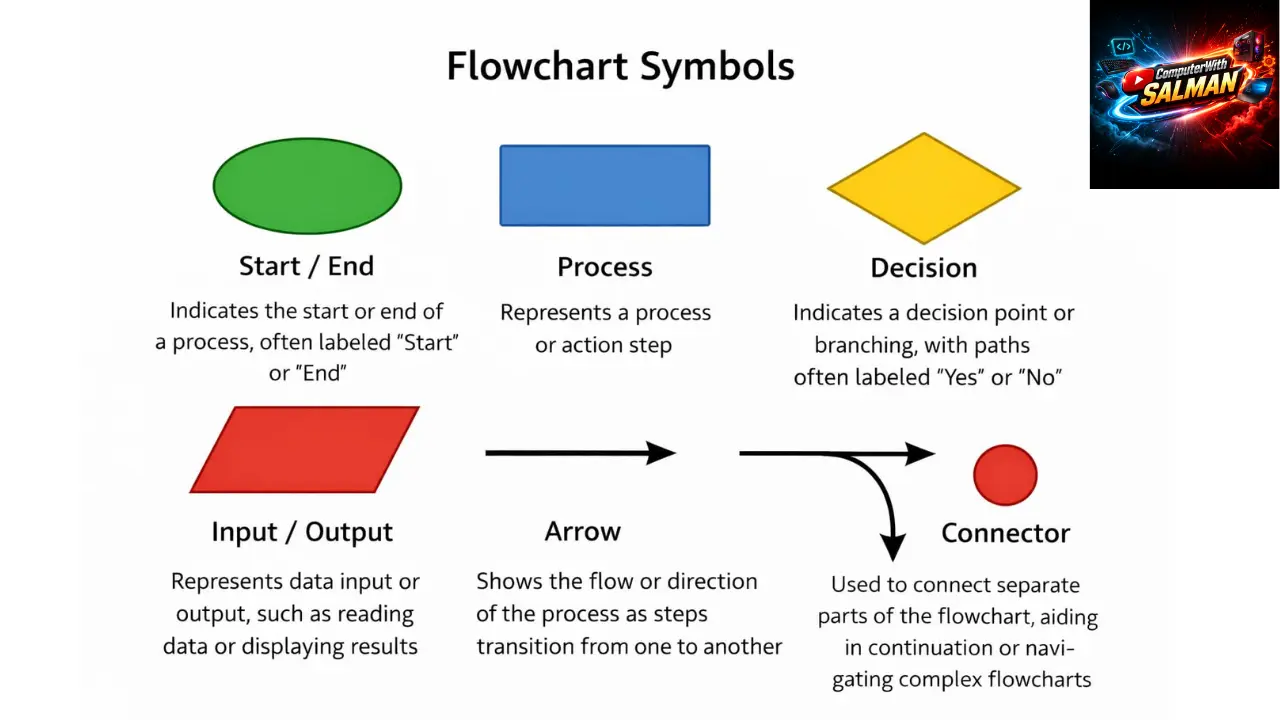
Flowchart Symbols
Pseudocode
Pseudocode is a way of writing an algorithm using simple English-like statements.
It is similar to programming logic but without strict syntax.
Example:
START
INPUT A
INPUT B
SUM = A + B
PRINT SUM
END
Why Use Pseudocode?
Clarity:Pseudocode is easy to understand because it focuses only on the logic of the solution without worrying about complex programming rules or syntax.
Planning:It helps programmers organize their ideas and plan the steps of the algorithm before writing real code.
Communication:It provides a simple way to explain algorithms to others, so everyone can understand the logic clearly, even without programming knowledge.
Flowcharts vs Pseudocode
Pseudocode:
Written in simple English.
Looks like a story.
Steps are written one by one.
Easy to convert into programming code.
Flowcharts:
Uses diagrams and symbols.
Looks like a visual map.
Shows flow using arrows.
Easy to understand the overall process quickly.
Multiple Choice Questions (MCQs)
1. What are algorithm design methods?
a. Programming languages
b. Techniques to design algorithms
c. Computer hardware
d. Internet tools
Answer: b. Techniques to design algorithms
2. Which of the following is an algorithm design method?
a. Flowchart
b. Keyboard
c. Monitor
d. Printer
Answer: a. Flowchart
3. Flowcharts are:
a. Programming languages
b. Diagrams showing steps
c. Hardware devices
d. Internet tools
Answer: b. Diagrams showing steps
4. Flowcharts use:
a. Only text
b. Symbols and arrows
c. Numbers only
d. Binary code
Answer: b. Symbols and arrows
5. Flowcharts are used in:
a. Computer Science only
b. Business only
c. Engineering only
d. All of these
Answer: d. All of these
6. Flowcharts help in:
a. Making problems harder
b. Understanding processes clearly
c. Ignoring problems
d. Playing games
Answer: b. Understanding processes clearly
7. Which of the following is NOT an importance of flowcharts?
a. Clarity
b. Communication
c. Confusion
d. Documentation
Answer: c. Confusion
8. Pseudocode is written in:
a. Binary language
b. Machine code
c. Simple English-like statements
d. Assembly language
Answer: c. Simple English-like statements
9. Pseudocode is used to:
a. Design algorithms
b. Repair hardware
c. Browse internet
d. Play games
Answer: a. Design algorithms
10. What is the first step in the given pseudocode example?
a. INPUT A
b. START
c. PRINT SUM
d. END
Answer: b. START
11. Pseudocode helps in:
a. Planning algorithms
b. Drawing diagrams
c. Fixing computers
d. Watching videos
Answer: a. Planning algorithms
12. Flowcharts are best for:
a. Writing code
b. Visual representation
c. Hardware design
d. Typing documents
Answer: b. Visual representation
13. Pseudocode looks like:
a. A diagram
b. A story in simple English
c. A picture
d. A graph
Answer: b. A story in simple English
14. Flowcharts show:
a. Only text
b. Only numbers
c. Flow of steps using arrows
d. Programming syntax
Answer: c. Flow of steps using arrows
15. Which method is easier to convert into code?
a. Flowchart
b. Pseudocode
c. Diagram
d. Symbol
Answer: b. Pseudocode
Test Yourself: Interactive MCQs (Computational Thinking)
1. What are algorithm design methods?
2. Which of the following is an algorithm design method?
3. Flowcharts are:
4. Flowcharts use:
5. Flowcharts are used in:
6. Flowcharts help in:
7. Which of the following is NOT an importance of flowcharts?
8. Pseudocode is written in:
9. Pseudocode is used to:
10. What is the first step in the pseudocode example?
11. Pseudocode helps in:
12. Flowcharts are best for:
13. Pseudocode looks like:
14. Flowcharts show:
15. Which method is easier to convert into code?
FAQs
Algorithm design methods are techniques used to create step-by-step solutions to solve problems efficiently.
The two common methods are Flowcharts and Pseudocode.
A flowchart is a diagram that shows the steps of a process using symbols and arrows.
Flowcharts are used in computer science, engineering, business, and many other fields.
Flowcharts help in understanding processes clearly, improving communication, solving problems, and keeping records.
They present steps in a clear and organized visual format, making them easy to understand.
Pseudocode is a simple way of writing algorithms using English-like statements similar to programming logic.
Pseudocode is used to plan and organize the logic of a program before writing actual code.
No, pseudocode is not a programming language. It is a simple way to describe logic.
It is easy to understand and focuses only on the logic without worrying about syntax.
It helps explain algorithms clearly to others, even those who do not know programming.
Flowcharts use diagrams and symbols, while pseudocode uses simple English-like text.
Pseudocode is easier to convert into programming code.
Flowcharts are better for visual understanding of processes.
Yes, both can be used together to design and understand algorithms more effectively.